
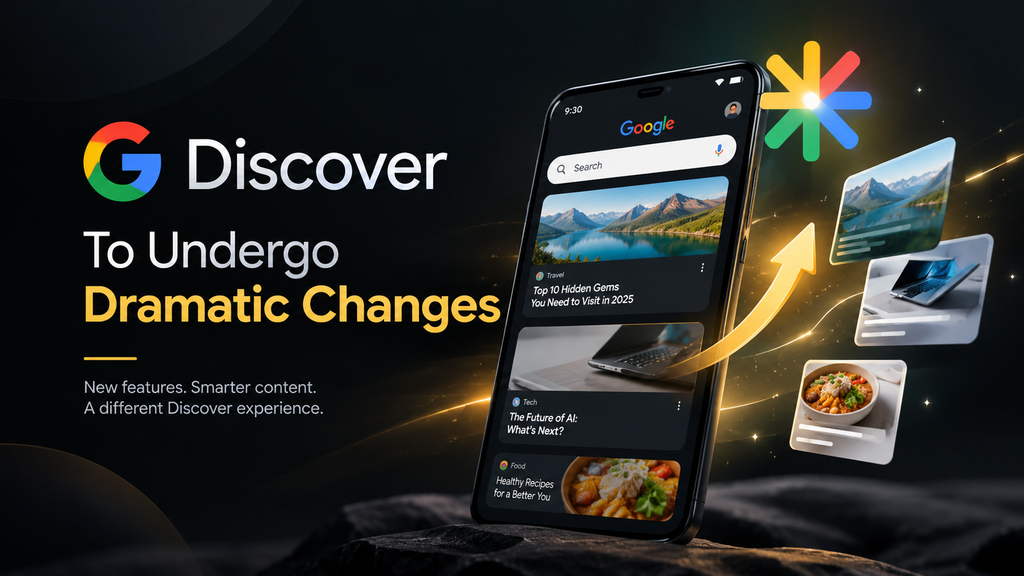
Google Discover’s AI Concierge: Will Smaller Publishers Win or Lose?Google Discover changes.
Google Discover has become a source of referral traffic for publishers, bloggers, and digital media websites. Unlike Google Search, which answers a user’s question, Discover suggests content based on what a person likes, how they browse, and other clues-Google Discover changes-2026
But what if Discover becomes more like an AI assistant helping people find information through tailored suggestions?
For publishers, the chances are exciting, but the dangers are real. Small websites might get attention by making original, useful content. Alternatively, they might lose visitors if AI makes it less necessary for users to go to websites.
The bigger question is how publishers should get ready for this change without making changes based on guesses-Google Discover changes-2026.
What Could an AI-Powered Google Discover Mean for Publishers?-Google Discover changes-2026
An AI-powered discovery process could make the content suggestions more tailored and aware of context-Google Discover changes-2026
Instead of just using known categories and popular stories, an AI assistant could help users explore topics based on their interests, what they did recently, and what they need to know.
For publishers, this could mean ways to connect with the right people.
It’s important to tell the difference between a possible future and an actual change. Publishers should look closely at what they hear before thinking that every new feature is a change-Google Discover changes-2026
The main thing still matters: make content that gives value to readers.
What to Check First When Google Discover Traffic Drops-Google Discover changes-2026
When Discover traffic goes down, the first thing to do is look at the data, not blame a Google update.
Google Search Console has a Discover performance report for websites that have Discover data.
Start by looking at clicks, impressions, and the rate at which people click on the content during the time when traffic dropped-Google Discover changes-2026
Then look into three areas:
1. Find out if the drop affects the website.
Check whether Discover traffic is down on most of your articles or on a few pages.
A drop across the site and a drop in just a few articles might have different reasons.
2. Look at each article’s performance.
Find the articles that got Discover traffic before. Check for changes in impressions, clicks, and the click-through rate.
A drop in impressions means less visibility, while a drop in click-through rate means fewer people clicked when they saw the content. Neither one alone tells the story.
3. Check content and audience trends.
Think about whether the articles covered things that were temporary breaking news, seasonal topics, or subjects that no longer interest people-Google Discover changes-2026
Also look at when you published the articles and any technical or indexing problems.
The goal is to find proof before making any changes.
A Typical Discover Traffic Drop Situation
Imagine a publisher whose article gets a lot of Discover views after an event in their field.
At first, the article gets thousands of views. Brings more visitors to the site. A day later, the views start to drop-Google Discover changes-2026
The publisher thinks an update caused the drop and considers changing the article.
The Search Console data shows that the drop is only in that one article, not the whole site.
One possible reason is that people are no longer interested in the event.
This is a made-up example, not a case. It shows why publishers should look at page-level performance before blaming an update-Google Discover changes-2026
The Biggest Mistake: Blaming Every Drop on an Algorithm Update-Google Discover changes-2026
Algorithm updates can change how content is seen, but not every drop in traffic means an update is to blame.
Discover traffic can change based on what people’re interested in, how relevant the content is, how much attention it gets, and the choices the recommendation system makes-Google Discover changes-2026
A publisher who quickly thinks an update caused the drop might change content that was working fine.
Instead, follow a careful process:
Compare how things did before and after the drop.
Check whether the change affects the site or just some articles.
Look at impressions, clicks, and the click-through rate on their own.
Look for patterns across articles instead of just one.
Check for news and official Google messages for proof of changes.
The main idea is simple: look at the data before changing the way you do things.
Will an AI Assistant Help or Harm Smaller Publishers?-Google Discover changes-2026
The answer could go either way.
A personalized discovery experience might offer chances for smaller publishers that are good at specific subjects.
A website that gives analysis, practical advice, or real-life experience may offer something that general content can’t copy easily-Google Discover changes2026
AI could also cause problems if people get enough information in the discovery system to meet their needs without going to the publisher’s site-Google Discover changes-2026
This matters because publishers often depend on website visits for ads, subscriptions,. Sales.
Three things will be really important.
1. Originality Over Quantity
Publishing more articles doesn’t always make a site more valuable.
Smaller publishers should focus on reporting, real examples, expert opinions, and ideas based on real experience-Google Discover changes.
The goal is to give readers a reason to choose their content.
2. Trust and Subject Knowledge
Publishers should build an area of expertise in the topics they write about.
Quality, accurate facts, clear sources, and helpful content can help build trust with readers.
Instead of chasing every hot topic, smaller sites can benefit from focusing on areas where they truly know what they’re talking about.
3. Diversify Traffic Sources
Relying on Discover is risky.
Even a site that does now may have big changes tomorrow.
Publishers should find ways to reach their readers, including regular search, email newsletters, direct visits, relevant social media groups, and returning visitors-Google Discover changes-2026
Discover can be a way to get visitors without being the only one.
One Practical Step Publishers Can Take This Week
Start by checking your 10 performing articles on Discover.
You don’t need an SEO tool to start. Google Search Console can be a place to begin-Google Discover changes-2026
Step 1: Find Your Top 10 Articles
Open your site’s Discover performance report in Search Console, choose a date range, and look at the pages that got the clicks-Google Discover changes-2026
If Discover reports are not available for your site, you may not have Discover data to qualify.
Step 2: Compare Performance Numbers
For each article, look at:
Clicks: How many visits did Discover bring?
Impressions: How often did the article show up in Discover?
CTR: What percentage of impressions resulted in clicks?
How the article has done over time: Is the interest just a short burst?
Don’t treat any one number as the full explanation of performance.
Step 3: Check the Content
Ask yourself:
Does this article give ideas?
Is the information correct and up to date?
Does it answer what readers might want to know?
Does it give something more than just a simple summary?
Are the title and image a good match for the actual content?
Update articles when there is a chance to make them better. Avoid changing content that works just because the traffic dropped-Google Discover changes-2026
Step 4: Build Another Traffic Source
Pick one way to get visitors and start working on it regularly.
For example, start an email newsletter that brings readers back to your site when you post something.
Alternatively, improve your search strategy by making topic clusters and linking articles with internal links.
The goal is to not depend on one recommendation system-Google Discover changes-2026
How to Tell Real Google Discover Tests From Noise-Google Discover changes-2026
Publishers often see pictures, social media posts, and reports about Discover features.
A test with Threads suggestions, for example, might make people wonder if Google is changing how it recommends content-Google Discover changes-2026
The problem is figuring out if what you see is a test, a small change, or just a one-time thing.
A good way to check has three parts.
Part 1: A clue
One person says they saw something.
This is worth checking. It’s not enough to say Google is testing it widely.
Part 2: A pattern
Several people say they saw the thing, preferably on different devices, accounts, or places.
Seeing the thing more than once gives better proof that it might not be an isolated case. It still doesn’t show the plan or if it will last.
Part 3: Confirmation
Real reports from the industry, things you can see for yourself, or a message from Google provide proof.
Then publishers should tell the difference between a small test and a real change.
This helps stop guessing from becoming an SEO tip.
One thing is a clue. Many things are a pattern. Real proof gives support.
Until you have proof, describe a new feature as a reported idea or possible test, not a confirmed change.
What Should Publishers Do Next?-Google Discover changes-2026
Google Discover will still be worth watching for publishers whose readers rely on personalized content.-Google Discover changes-2026
Getting ready for possible AI changes doesn’t mean giving up on current SEO plans.
Publishers should focus on the following:
Check how Discover is doing using Google Search Console.
Look into drops in traffic before blaming an update.
Make relevant reader-focused content.
Build skills in topics they know well.
Create ways to get visitors and build stronger relationships with readers.
Check reports about features before changing how you do things.
These steps are still useful even if Google’s future Discover changes.
Final Thoughts
The idea of an AI-powered Google Discover raises questions about visibility, personalization, and the future of publisher traffic-Google Discover changes-2026
Smaller publishers could gain if recommendations make it easier for unique expert content to be seen. They could also face problems if AI makes it less necessary for people to visit websites.
For now, the best move is to focus on what publishers can control: content quality, reader trust, and getting traffic from one place.
Rather than chasing every reported experiment, publishers should create websites that offer real value to readers.
The best approach is not to rely on Discover working the way it does tomorrow. It is to create a publication that can change when it needs to-Google Discover changes-2026
Frequently Asked Questions
1. Why does Google Discover traffic suddenly drop?
Discover traffic can go down because of changing reader interests, visibility for content, more competition, or other factors that influence what gets recommended. Use Google Search Console to compare impressions, clicks, and CTR before deciding what caused the drop-Google Discover changes-2026
2. Does a Discover traffic drop mean a Google penalty?
No. A drop in Discover traffic does not mean a website has been punished or affected by an algorithm change. Look at the data and other signs before making any conclusions-Google Discover changes-2026
3. How can small publishers improve their Google Discover performance?
Create helpful content that meets the needs of a specific audience. Use headlines and relevant images, keep high editorial standards, and check Search Console data to see which articles readers like-Google Discover changes-2026
No single action ensures Discover visibility.
4. Will AI-powered Discover reduce website traffic?
It is possible. The impact will depend on how Google’s Discover experience changes and how people use the recommended content. Publishers should watch performance rather than guess what will happen-Google Discover changes-2026
5. How do I check Google Discover performance?
Go to Google Search Console and choose your website. Look for the Discover performance report. If the report exists, check clicks, impressions, CTR, and how pages perform over time-Google Discover changes-2026
6. Should publishers stop focusing on Google Discover?
Not at all. Discover can still bring in traffic. The better idea is to see it as one part of a plan that also includes organic search, newsletters, direct visits, and other channels-Google Discover changes-2026
7. How can I tell if Google is testing a Discover feature?
Look for reports from sources, repeated sightings, and solid confirmation. Treat photos or one report as early signs, not proof of a full change-Google Discover changes-2026
SEO Publishing Package
SEO title: Google Discover AI Changes: What Publishers Should Know-Google Discover changes-2026
Meta description: Discover how potential AI changes could affect publishers; check for traffic drops, watch for features, and grow traffic beyond Google Discover changes-2026
Suggested URL slug: google-discover-ai-changes
keyword: Google Discover changes-2026
keywords:
Google Discover traffic drop
Google Discover AI
Google Discover SEO
Google Discover traffic recovery
Google Discover algorithm update
Suggested excerpt:
Google Discover may change as AI improves how content is recommended. Learn how publishers can check for traffic drops, look into reported experiments, and get ready for changes without guessing-Google Discover changes-2026
Featured Image Prompt
Design a quality editorial image for an SEO and digital marketing article about the future of Google Discover and AI-driven content recommendations. Use a background with soft gold lighting, a glowing digital content feed, abstract AI connections, and clean data visuals. Show a contrast between an independent publisher and a larger content network. Modern, simple, professional cinematic lighting, realistic 3D elements, strong contrast, layout with plenty of space for a headline in a 16:9 landscape format. Avoid Google logos, fake interface text, and messy details.
Additional Image Prompts
Image 2. Diagnosing Discover Traffic Drops
Design a dark-themed SEO analytics image with a digital dashboard showing impressions, clicks, CTR trends, and a graph that shows falling traffic. Black background, gold details, clean data visuals, premium editorial style, 16:9 landscape. Avoid made-up data, logos, and readable interface text.
Image 3. AI and the Future of Publishers
Design a conceptual image showing small digital publishers working in an AI-powered content discovery world. Show a network of article-reader connections, AI recommendation paths, and different traffic sources. Use a black-and-gold look, lighting, elegant 3D details, and a high-end tech-publishing style. 16:9 Landscape.
Schema Recommendation
Use the following data types where possible:
Article: Explains the article, its title, author, publication date, updated date, and featured image.
BreadcrumbList: Shows where the page fits in the website’s navigation.
Organization: Identifies the author or publisher.
An FAQ section can help readers. Adding FAQ structured data does not mean Google will show it as a rich result-Google Discover changes-2026
Check Google’s official documentation to make sure your setup is correct:
Article structured data documentation
Breadcrumb structured data documentation
Google Search Console Discover report documentation
Editorial note: This article talks about possible future changes, not confirmed action from Google. Before writing about Threads suggestions or specific experiments, check that the information is real. The traffic drop example is for explanation, not a real case-Google Discover changes-2026
Conclusion
Google Discover may be heading toward a more AI-driven, personalized experience, but for now that is a possibility, not a confirmed change. For smaller publishers, the outcome could go either way. Original, expert-led content may get more chances to reach the right readers, while AI summaries could reduce the need to click through to a website.
You can’t control what Google tests next, but you can control how prepared you are. When traffic drops, check Search Console before blaming an update. Compare clicks, impressions, and CTR, and look at page-level patterns before changing content that was working. Treat reports of new features as clues until they are backed by a pattern and real confirmation-Google Discover changes-2026
Connect with Freelance Digital Marketer in Thrissur Above all, build a publication that doesn’t depend on one source of traffic. Focus on original content, topics where you have real expertise, and channels you own, like search and email. If you do that, you’ll be in a strong position whatever Discover becomes.